Inside the Fairy-Tale Walls: Art and Illusion at Neuschwanstein
You know that castle you’ve seen in every dreamy screenshot, the one that looks like it leapt out of a storybook? Yeah, that’s Neuschwanstein. I stood beneath its turrets in Bavaria, jaw literally dropped, realizing this wasn’t just architecture—it was a masterpiece of 19th-century fantasy. Built by King Ludwig II, it’s more than a palace; it’s a living canvas. Every hall, mural, and staircase feels like stepping into a Wagnerian opera. This is art not hung on walls—but built into them. From the moment your eyes catch its silhouette against the Alpine sky, Neuschwanstein pulls you into a world where myth and masonry merge. It’s not merely a destination; it’s an emotional experience carved in stone, paint, and gold leaf.
The Dreamer Behind the Dream
Neuschwanstein was never meant to be a seat of political power. It was born from the imagination of a solitary king who saw reality as too harsh for his romantic soul. King Ludwig II of Bavaria, crowned at the age of 18, inherited a kingdom in transition, caught between tradition and the encroaching tide of industrial modernity. Yet he had little interest in governance. His passions lay elsewhere—in poetry, in music, in the medieval legends that stirred his heart. He was a man out of time, drawn to a world of knights, divine right, and celestial beauty. This inner world would become the foundation of Neuschwanstein.
Ludwig’s emotional refuge began to take shape after he was deeply moved by the operas of Richard Wagner. The composer’s grand themes of sacrifice, purity, and transcendent love resonated with the young king’s ideals. Wagner became not just an artist Ludwig admired, but a spiritual guide. When political tensions forced Wagner into exile, Ludwig provided him financial support, ensuring the composer could continue his work. This patronage was more than generosity—it was an act of devotion to a shared artistic vision. Neuschwanstein, in many ways, became Ludwig’s operatic stage, where every room was a set, every corridor a scene change.
The king’s retreat from public life only deepened as he poured his energy into the castle’s construction. He rarely entertained guests and never intended Neuschwanstein to be a royal residence in the traditional sense. Instead, it was a sanctuary, a physical manifestation of his inner world. He designed it not for others, but for himself—a place where art could replace politics, and dreams could take the form of towers and frescoes. In this, Neuschwanstein stands apart from other royal palaces. It is not a symbol of statecraft, but of personal longing.
Historians often describe Ludwig as eccentric, even unstable. Yet his vision was remarkably coherent. He was not escaping reality so much as redefining it through beauty. The castle’s every detail reflects a deliberate aesthetic philosophy. From the placement of windows to the symbolism in the carvings, nothing was left to chance. Ludwig worked closely with architects, providing detailed sketches and insisting on specific themes. He saw the building not as a project, but as a mission—to create a space where art and emotion could reign supreme.
Architecture as Theater
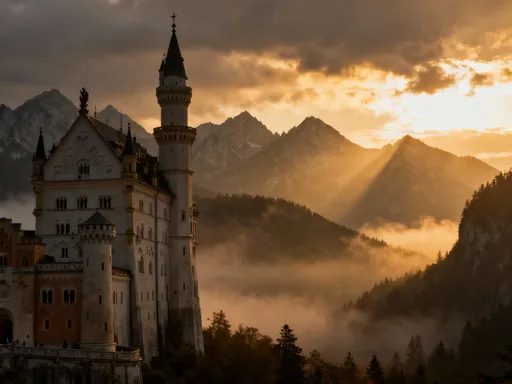
Approaching Neuschwanstein is an experience designed to overwhelm. Perched atop a rugged hill in the Bavarian Alps, the castle emerges from the mist like a vision. Its silhouette—turrets piercing the sky, towers crowned with domes, walls rising from rocky outcrops—feels less like a structure and more like a character in a legend. This effect was no accident. Ludwig and his architects, particularly Christian Jank and Eduard Riedel, treated the landscape as a stage. Every angle, every approach was calculated to maximize awe.
The castle’s exterior blends Romanesque, Gothic, and Byzantine elements, but not in the name of historical accuracy. These styles were chosen for their emotional resonance, not their authenticity. The rounded arches and fortress-like base evoke the strength of medieval fortresses, while the soaring spires and ornate balconies suggest divine aspiration. The result is a hybrid—a fantastical interpretation of the past, more poetic than precise. It’s architecture as storytelling, where form follows feeling rather than function.
One of the most striking aspects of Neuschwanstein’s design is its relationship to the surrounding landscape. The castle is positioned to be seen—and to be seen from afar. Visitors approaching from the valley below must walk or ride through dense forests, catching only glimpses of the towers through the trees. Then, suddenly, the full view opens up from Marienbrücke, the famous bridge across the gorge. This dramatic reveal is no coincidence. It mirrors the crescendo of an opera, building anticipation before the grand unveiling. The journey itself becomes part of the performance.
Even the materials were chosen for their visual impact. The white limestone façade gleams in the sunlight, contrasting with the dark timber of the surrounding forests. The copper domes, initially green with patina, were later restored to a bright turquoise, enhancing their fairy-tale quality. Windows are strategically placed to catch the morning and evening light, making the castle appear to glow at dawn and dusk. These effects are not merely decorative—they are essential to the castle’s purpose as a living work of art.
The Throne Room That Never Was
Inside Neuschwanstein, no space captures the king’s spiritual ambitions more than the Throne Room. Though grand in scale and rich in symbolism, it remains an enigma: there is no throne. Ludwig was never crowned as king in a formal ceremony, and this room, rather than serving a political function, was intended as a sacred space—a temple to the idea of monarchy. Its design draws heavily from Byzantine churches, particularly the Hagia Sophia, with its central cupola, intricate mosaics, and elevated platform.
The room is dominated by a massive chandelier made of silver and gilded bronze, shaped like a Byzantine crown. Twelve bronze statues of the apostles circle the base of the dome, reinforcing the divine nature of kingship. The floor is inlaid with colorful stones forming symbolic patterns, while the walls rise into a golden mosaic depicting scenes from the life of Christ. Light filters in from above, casting a celestial glow that transforms the space into something otherworldly. Every detail is meant to elevate the visitor, not to a seat of power, but to a state of reverence.
The absence of a throne is deliberate. It underscores that this room was never about authority in the earthly sense. Instead, it reflects Ludwig’s belief in the sacred duty of the monarch—a ruler chosen by God, not by politics. The space is more chapel than court, more liturgy than legislature. It’s a testament to a worldview that saw leadership as spiritual, not administrative. In this way, the Throne Room becomes a monument to an ideal, not a tool of governance.
Despite its grandeur, the room was never used for any official ceremony. Ludwig spent little time in the castle during his lifetime, and after his death in 1886, Neuschwanstein was opened to the public just weeks later. What was meant to be a private sanctuary became a public spectacle. Yet even today, visitors often fall silent upon entering the Throne Room. The emotional weight of the space—the fusion of faith, art, and ambition—still resonates. It’s a reminder that some of the most powerful spaces are those built not for use, but for meaning.
Wagner in the Walls
If the Throne Room speaks to divine kingship, the Singer’s Hall proclaims Ludwig’s devotion to music. This vast, two-story chamber was designed as a space for imagined performances of Wagner’s operas. Though it was never used for actual concerts during Ludwig’s lifetime, its acoustics and layout suggest a deep understanding of theatrical experience. Long wooden benches line the walls, facing a raised stage adorned with intricate carvings of musical instruments and mythological figures. The ceiling is painted with scenes from the legends that inspired Wagner’s works—Lohengrin, Tannhäuser, and Parsifal.
Ludwig envisioned this hall as a place where art and audience could unite in transcendence. He dreamed of hosting intimate performances, where the music would echo through the stone and lift the soul. The room’s design reflects this ideal. The wooden panels were crafted to enhance sound, creating a warm, resonant atmosphere. Even the lighting—originally planned to be candlelit—was meant to evoke the flickering glow of a medieval hall. Though no opera was ever staged here in Ludwig’s time, the space remains a tribute to the power of music.
The influence of Wagner extends far beyond this single room. Throughout the castle, murals depict scenes from his operas. In the bedroom, a painting shows Lohengrin arriving in a boat drawn by a swan—a direct reference to the opera that so captivated Ludwig. In the study, reliefs of Tannhäuser appear alongside quotes from the libretto. These are not mere decorations. They are acts of devotion, visual prayers to the artist who shaped the king’s inner world.
Wagner’s themes—redemption, purity, the conflict between sacred and profane—mirror Ludwig’s own struggles. The king saw himself as a guardian of true art in a world that valued commerce and power. By embedding Wagner’s stories into the very walls of Neuschwanstein, he created a monument not just to a composer, but to the idea of art as salvation. The castle becomes, in this light, a kind of opera without words—a silent performance of love, loss, and longing.
Murals, Mosaics, and Hidden Narratives
Walking through Neuschwanstein is like moving through a painted epic. Every ceiling, every wall, every vault is covered in elaborate artwork. Knights in armor ride through enchanted forests, swans glide across moonlit lakes, and celestial figures descend from golden skies. These murals are not random. They are carefully curated scenes drawn from Germanic legends, medieval romances, and Christian iconography. Each tells a story, and together, they form a narrative tapestry that reflects Ludwig’s ideals.
The craftsmanship behind these works is extraordinary. Ludwig hired skilled artisans from across Europe, giving them detailed instructions on composition, color, and symbolism. Many of the painters had experience in theater set design, which explains the dramatic lighting and theatrical poses of the figures. The murals are not meant to be realistic. They are dreamlike, exaggerated, designed to evoke emotion rather than document history. Gold leaf is used liberally, catching the light and adding a sense of divine radiance.
One of the most recurring symbols is the swan. It appears in paintings, carvings, and even as functional objects—swan-shaped handles, swan motifs on furniture. This is a direct reference to Lohengrin, the knight of the Holy Grail who arrives in a boat pulled by a swan. In the opera, Lohengrin is a figure of purity and mystery, bound by a vow of secrecy. Ludwig identified with this character—a noble soul misunderstood by the world, bound by higher laws. The swan becomes a personal emblem, a quiet declaration of identity hidden in plain sight.
Other symbols carry deeper meanings. The use of celestial imagery—stars, angels, divine light—reflects Ludwig’s belief in a spiritual hierarchy. The frequent depictions of knights on quests suggest a personal journey toward truth and beauty. Even the choice of colors has significance: blue for loyalty and faith, red for sacrifice, gold for divinity. These elements combine to create an environment that is not just beautiful, but meaningful—a space designed to inspire contemplation and elevate the spirit.
The Visitor Experience: Between Tourism and Reverence
Today, Neuschwanstein welcomes over 1.4 million visitors each year. The journey to the castle begins in the village of Hohenschwangau, where tourists gather to board horse-drawn carriages or shuttle buses for the ascent. Many choose to walk the winding forest path, a 20-minute climb that builds anticipation. As the trees part and the full view emerges, a collective hush often falls over the group. That moment—when the castle comes into full view—is still powerful, just as Ludwig intended.
Once inside, the experience shifts. Visitors move in guided groups, following a one-way route through the furnished rooms. Photography is not allowed, a rule that, while sometimes frustrating, helps preserve the atmosphere. The lack of personal photos may seem like a restriction, but it also encourages presence—asking guests to absorb the space with their eyes, not their phones. The guides speak in hushed tones, emphasizing the castle’s artistic significance and Ludwig’s tragic story.
Yet there is a tension between the site’s original purpose and its modern reality. Ludwig built Neuschwanstein as a private retreat, a place of solitude and reflection. Today, it is one of Germany’s most popular tourist destinations. The crowds can feel at odds with the intimacy the king sought. Some rooms, like the bedroom and study, are small and delicate, designed for quiet contemplation, not mass visitation. The wear and tear of millions of footsteps is evident, despite careful preservation efforts.
Still, something of Ludwig’s vision endures. Even in the busiest hours, visitors often pause, gaze upward at the painted ceilings, or stand silently in the Throne Room. There is a recognition—spoken or unspoken—that this is not just a castle, but a work of art. The emotional core of Neuschwanstein remains intact. It invites not just sightseeing, but feeling. In a world of fast travel and digital distractions, it offers a rare chance to step into a dream.
Neuschwanstein’s Legacy in Art and Imagination
Neuschwanstein’s influence extends far beyond Bavaria. Its image has become synonymous with fairy-tale romance, inspiring countless representations in film, animation, and design. Most famously, it served as the model for Sleeping Beauty’s castle in Walt Disney’s 1959 animated film—and later, for the iconic Cinderella Castle at Disneyland. Disney himself visited Neuschwanstein and was captivated by its otherworldly beauty. The connection is fitting: both Ludwig and Disney were dreamers who used art to create immersive worlds.
The castle’s legacy is not just in its imitations, but in its enduring message. It proves that architecture can be more than shelter. It can be poetry. It can express longing, faith, and the human desire to transcend the ordinary. In an age of functional design and minimalist aesthetics, Neuschwanstein stands as a reminder that beauty matters—that emotion can and should shape our spaces.
For modern travelers, especially those who value meaning as much as sightseeing, Neuschwanstein offers more than a photo opportunity. It invites reflection on the role of art in life. It asks us to consider what we build—not just homes or cities, but dreams. Ludwig may have been a king out of step with his time, but his vision speaks to timeless truths: that imagination is powerful, that solitude can be sacred, and that the most lasting structures are those built from the heart.
As the sun sets behind the Alps and the castle glows in the twilight, it’s easy to understand why Neuschwanstein continues to captivate. It is not perfect. It was never finished. And yet, in its unfinished grandeur, it feels more alive than many completed works. It remains a testament to the courage of creating something purely for beauty’s sake—a world where art is not an addition, but the foundation.